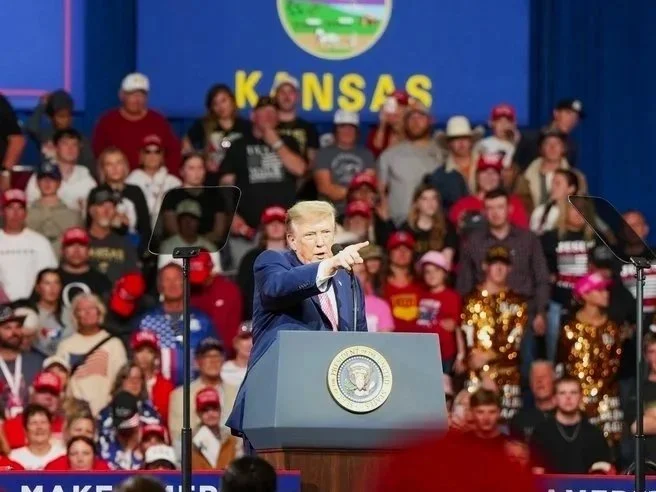
Yesterday, nothing surprising happened. But that does not mean it was not eventful.
The President of the United States flew to Kansas to speak at a rally in Wichita. In the rally, he stumped for the Republican nominee for Senate from the State of Kansas. During his speech, he lied repeatedly. He lied about 22 trillion dollars of foreign investment, the state of immigration, manufacturing plants, and oh so much more. And, if you think I’m just sharing my opinion, I’m referring here to the KC Star’s speedy fact check of his speech.
Donald Trump also lied about my senior pastor and my Church. The Democratic nominee for US Senate from Kansas is my boss, Rev. Adam Hamilton, lead pastor of the Church of the Resurrection, the wonderful congregation I serve as a discipleship pastor. The President, in an effort to rally for the midterms, fabricated wild claims about Adam’s leadership record, stance on cultural flashpoints, and sermonic admonitions. Again, if you think I’m being biased here, I’m just referencing the fact checking article (and countless others like it).
Nothing surprising happened - the President flew in and lied. We’re used to it. In the world of politics, we’ve almost accepted it. That’s the game, right?
I wonder what “the game” is to God? I have two degrees in biblical studies, and those pesky degrees are keeping me up tonight. Or is it something more active and alive pushing back my sleep? Tonight, like Samuel, I’m hearing a whisper, and it’s asking me this: we may have given up on telling and hearing the truth. But when we examine the Scriptures, do we find that telling the truth matters to God?
The Biblical Witness
In the Old Testament, the command to tell the truth shows up in several places. Most famously, the Ninth Commandment, delivered to Moses on Sinai, says “Do not bear false witness” (Exodus 20:16). Leviticus 19, the same chapter that contains the foundational command to “Love your neighbor as yourself,” also says, “Do not steal. Do not lie. Do not deceive one another.” The plain letter of the law lays it out literally.
It shows up in other places, too. The prophets highlight the importance of truth-telling to a just society. "These are the things you are to do: Speak the truth to each other, and render true and sound judgment in your courts,” Zechariah says (8:16). The Wisdom literature connects truth-telling to a righteous character. “Lying lips are an abomination to the LORD, but those who act faithfully are his delight,” says Proverbs 12:22. Psalm 15 says this: “Lord, who may dwell in your sacred tent? Who may live on your holy mountain? The one whose walk is blameless, who does what is righteous, who speaks the truth from their heart;whose tongue utters no slander, who does no wrong to a neighbor, and casts no slur on others.”
These passages point us to what I think is the primary claim of the Bible when it comes to telling the truth: being truthful is being missional.
Let me explain. Throughout the Old Testament, God makes it clear that he is on a mission to redeem the world from its brokenness, but that he will not do it alone. God instead partners with human beings to carry out that mission of redemption. Human beings carry God’s image, and they are supposed to live in such a way that their conduct and behavior reflect the divine character. Later, when God calls the Hebrew people to carry a special responsibility in this mission, he tells them that the whole world will look to them to see who God is - which can only happen if they are living according to God’s intentions. How the community acts has a direct impact on what the rest of the world thinks about God.
God takes this assignment so seriously because his reputation is on the line. If the whole world looks upon God’s chosen people and finds only corruption, they might get the wrong idea about who God is. Ezekiel takes up this theme forcefully: “It is not for your sake, people of Israel, that I am going to do these things, but for the sake of my holy name, which you have profaned among the nations where you have gone.” God knows that when people look to those who carry his very name, it has a terrible impact when they act falsely.
The New Testament doesn’t skip a beat. In the Sermon on the Mount, Jesus says, “Let your ‘yes’ be ‘yes’ and your ‘no’ be ‘no.’” Ephesians 4:25 says, “Each of you must put off falsehood and speak truthfully to your neighbor, for we are all members of one body.” Colossians 3:9 says, “Do not lie to each other, since you have taken off your old self with its practices.” These passages explicitly connect the Church’s mission to spread the healing gospel of Jesus to the ways in which we tell the truth to one another.
Okay, so, the idea is there. Telling the truth seems to matter to God quite a bit. It comes as no surprise, then, that the lack of truth-telling in the American Church is having an impact on people. According to a 2023 Barna study, the primary driver of doubt among those who have walked away from Christianity is, you guessed it, hypocrisy. In other words, when the world looks upon the Church and sees falsehood, they get a bad idea of who God is.
Do the Ends Justify the Means?
Why, then, have so many Christians accepted lying as a common practice among leaders? Why are MAGA rallies full of God’s name and lies at the same time? Of course, it’s not just MAGA rallies, but the broader political world, too. It’s in city halls, debate stages, and yes, even pulpits. To be clear, I know that the truth can be relative. I’m not naive to the ways in which various people groups and denominations define truth differently.
Why is it, though, that Christians can’t embrace fact-checking? It is well documented that Christians distrust fact-checking outlets, like the one I cited above. The “corrupt” media that has the nerve to fact check a political speech is somehow evil for speaking against a candidate with an allegedly Christian agenda. Maybe that’s it, then? Maybe Christians have been duped by their leaders into thinking facts are an affront to righteousness?
No, I don’t think so. I think many Christians know that the lies are lies, but that for some reason, the lies are excusable if they serve some larger purpose. Somehow, millions of Christians have convinced themselves of this agenda. God is using an imperfect vessel to bring righteousness and moral influence back to our country, and if he’s lying (and if he encourages us to do the same thing), then it’s all part of the greater good, right?
The question facing the Church is this: do the means justify the ends?
In my humble opinion, unequivocally no.
In the Kingdom of God, the ends do not justify the means.
In the Kingdom of God, the ends and the means are the same thing.
You cannot separate Christ’s intention to heal our broken world from the ways in which Christ actually spoke, lived, and called us to follow. And if you’ve ever felt that tension in your gut, something deep and painful telling you that dishonesty, bullying, and fear-mongering is wrong but you have to be okay with it for some holy cause, you can be released from that today. It’s simply not true.
Does lying matter to God? Yes. And in that sense, something surprising did actually happen yesterday: many Christians, despite knowing better, cheered for lies.