One for the money,
Two for the show,
Three to make ready,
And four to go
Four to Go
It started with a bang. I pulled up to Harmon Park in Prairie Village and couldn’t believe how many cars lined the street. My Senior Pastor, Adam Hamilton, had called a press conference to make a big announcement. I wanted to be there to see it myself.
But this moment had been building for some time. A couple of months earlier in February, the staff of Resurrection were called together to receive big news. After a beautiful reflection on Black History Month led by one of my coworkers, Adam took the stage and shared that he was discerning a call to run for the United States Senate. If it is possible to be shocked but not surprised, that’s what we were. Shocked that our leader, who goes to such great lengths to hold the middle ground, was entering politics. Not surprised because we’ve seen him take bold action to do the right thing time and time again. After detailing how the church would handle this unusual season, he reminded us that he still needed time to discern.
Walking up to the park in April, I knew he was going to run. Why else hold a press conference, right? The park was small, and I walked a long street to get there. Adam and I actually arrived at the same time, crossing paths in the bustling parking lot. We exchanged pleasantries, and then I lingered behind so he could make his grand entrance. He greeted the crowd, the cameras, and the critics, then made his announcement - he would run for the United States Senate as a Democrat.
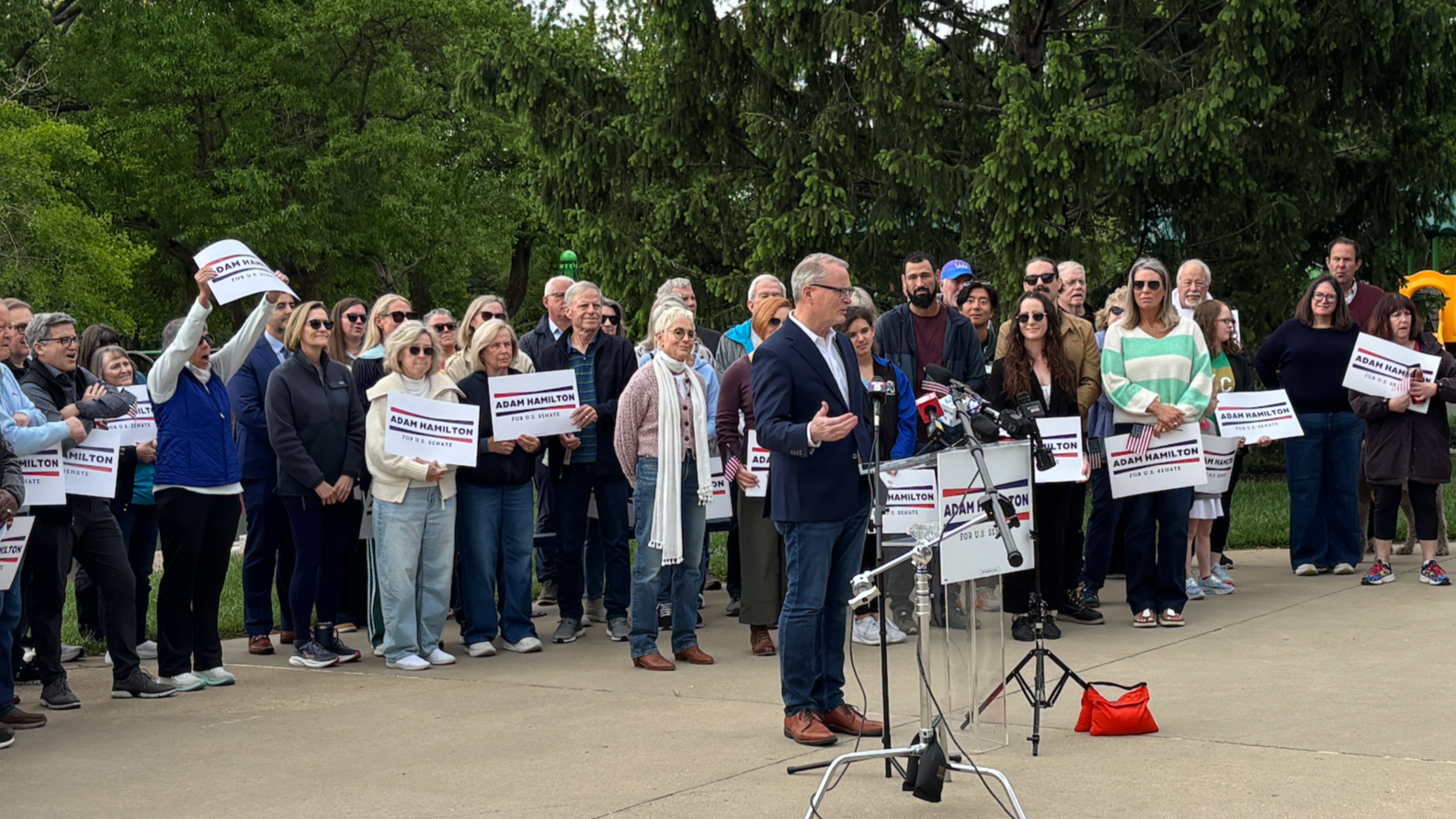
My vantage point of Adam’s announcement at Harmon Park, April 2026
He had entered the race. I jumped on his website that same day and filled out the volunteer interest form. Within two weeks, I was talking with a campaign staff person about how I could help. As one of the pastors at Resurrection, I felt like I had a unique opportunity to get involved, vouching for his leadership skills from my personal experience. I elected to use personal time to volunteer, taking special precautions to uphold the policies of the church. My wife was on board, and she decided to help out by watching our son during volunteer hours to free me up to help the campaign.
I entered the race with almost no hesitation. After the starting pistol fired, I sprinted.
Three to Make Ready
My driving passion is exploring how the psychology of interpersonal connection relates to spirituality. In other words, I like to study how knowing other people helps us come to know God better. God made us for community, I believe, and learning to pay attention to other people helps us pay attention God. This interest is what drives me.
It has been my opinion, though, that the political climate of the last 12 years has eroded our capacity levels to connect with other people. Our brains are just carrying too much noise to maintain relationships or make new ones. When we can invest in relationships with the energy we have, we tend to do it with people like us, which is much safer and less exhausting than meeting different kinds of people. The consequences of this burnout are many, but one of them can be a more shallow experience of faith, which is most fully lived out in community. Therefore, as a pastor, I care a great deal about our polarization.
Since I first met him, Adam Hamilton was laser focused on bringing unlikely conversation partners together in a community of faith. No wonder I jumped into the campaign race - I felt that if he won the election, he could make a difference in our communities by pushing back against the divisive language in Washington DC. Of course, he can’t do that by his own efforts, but he was the kind of person I wanted to support no matter the party.
And support his campaign I did. First, it was phone banking. I went to my basement several times a week and called whatever number the database spat out. Most of those calls were non answers, but about one in ten people picked up and talked to me. Those conversations confirmed what I knew all along - that peoples’ capacity levels to talk with a person different than them is low. I was cussed out several times, and a handful of people informed me that Adam Hamilton’s church was apostate (it was always fun when I revealed my true identity as a pastor at said church). Some calls were lovely, though, especially from the opposers. For every three people who disliked what the campaign stood for, one was willing to listen.
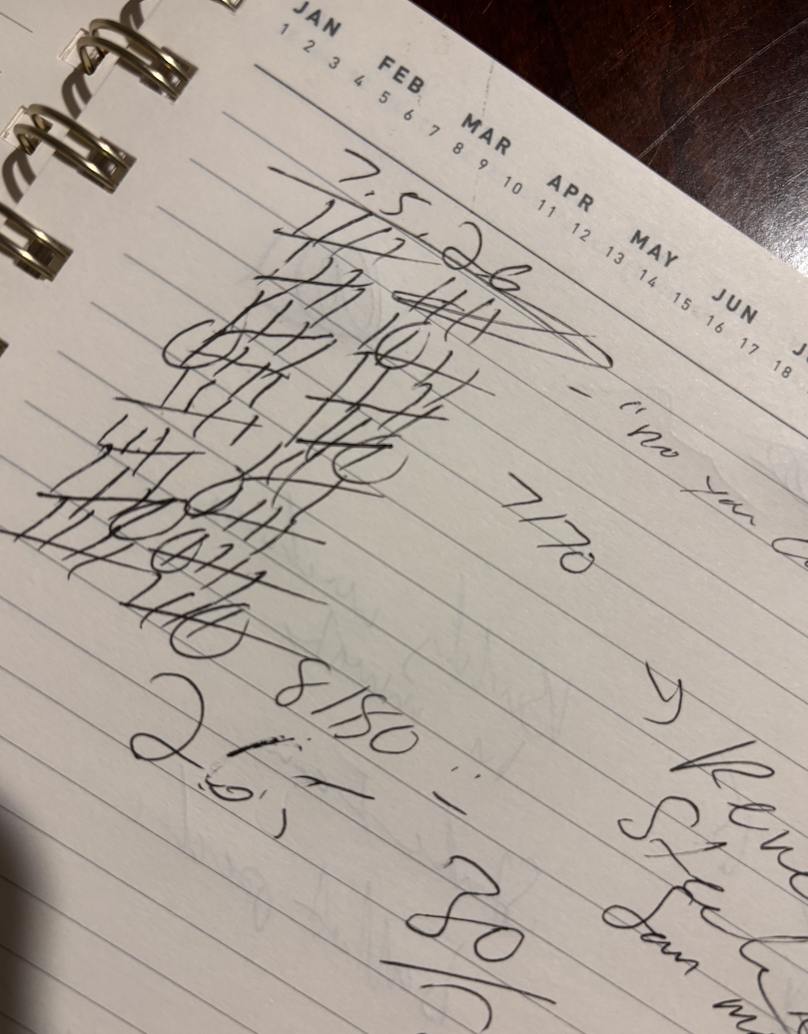
My chicken scratch notes from an evening of phone banking. I would tally each phone call and circle attempts that were answered. After meaningful conversations I would take notes, capturing details of the person and what was on their mind.
Soon after phone banking came my favorite part, canvassing. I was a part of the first group of canvassers to go door-to-door for the campaign, and it came with anxiety at first. Walking up to a door with printed materials in hand made me remember all the people I’ve ignored on my porch. (To all of you - I’m sorry! I get it now!) Most people didn’t answer, but probably one out of five knocks resulted in a conversation. Oftentimes, those interactions were life-giving (my friend, Dave, and I helped rescue an escaped dog during a canvassing trip. We earned that homeowner’s vote!) The pushback was still there, though. People tend to be more kind to people they disagree with when they’re standing at their door, but they didn’t hold back what they felt about Adam, the “Methodists,” and the Democrats.
This season lasted from about June to September. Volunteers like me had made ready the work, even if the work was dismaying at times, illuminating our nation’s deep divisions.
The race was going about as well as expected. But nothing could prepare me for the show.
Two for the Show
Things began to shift in mid September. For one, Adam’s race was a competitive one, and the national media started to notice, especially after the first debate at the Kansas State Fair. As the campaign grew in influence, my volunteer role began to shift. I started getting more involved with faith-based organizing, much of which led to nonpartisan outcomes of marches to the polls, organized prayer, and more. Behind the scenes, though, I was working with other United Methodist clergy who were wrestling with how to speak out about our political climate. These efforts were deeply rewarding.
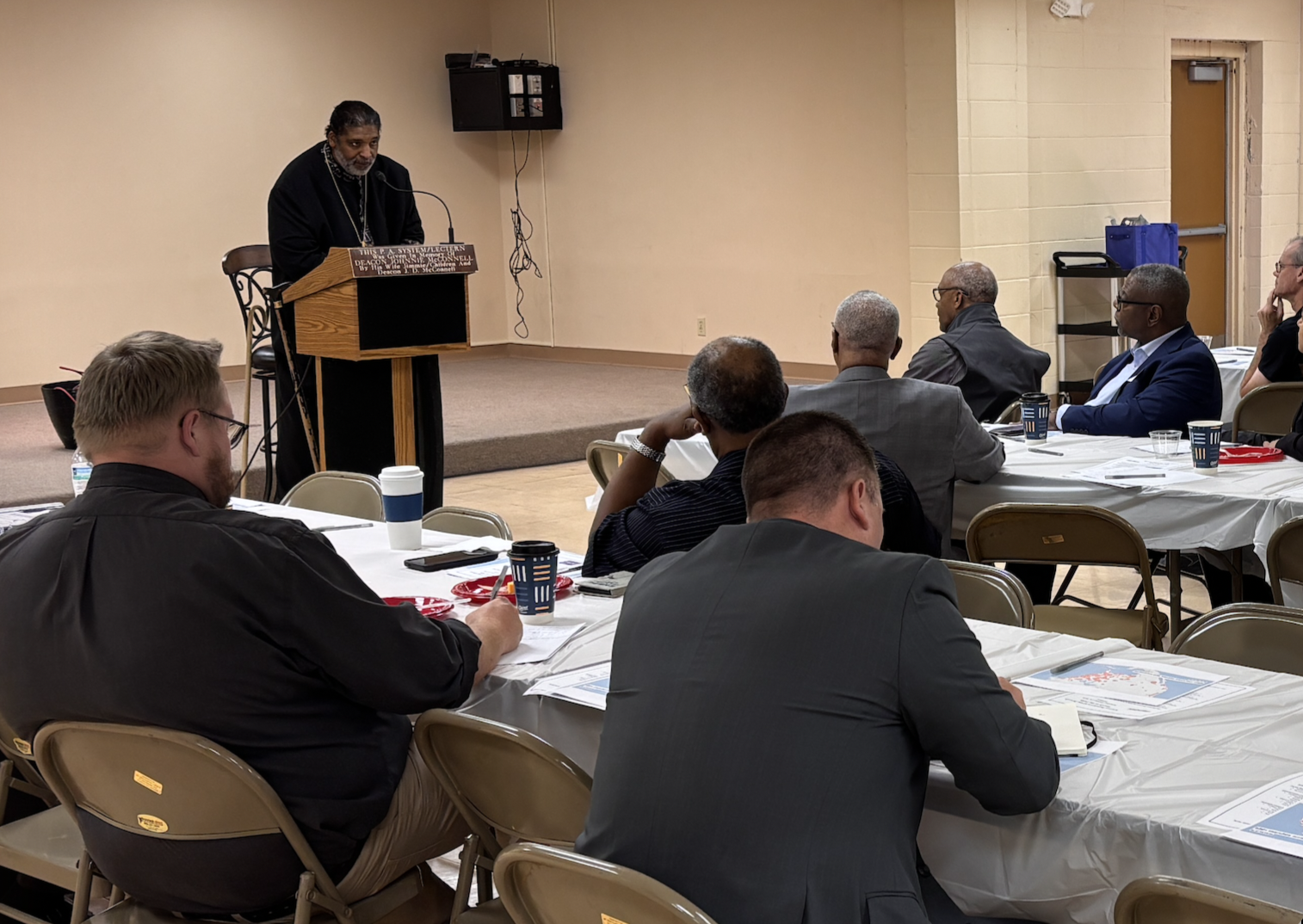
A highlight for me was helping organize a clergy gathering with Bishop William Barber, who inspired us to advocate for voter turnout and equality.
However, a heaviness was encroaching, its ominous weight felt more with each passing day. It started when the Vice President came to Olathe, just a stone’s throw from my backyard. To a room full of applauding supporters, he lambasted Adam and made up facts as he went. No surprise there. However, my stomach churned as he started to bring my church into the diatribe. Suddenly, it wasn’t just Adam; Resurrection was a target.
All sorts of fabricated, misleading stories emerged after the VP’s visit. He seemed to create a permission structure for Christians to demonize a congregation for political gain. Stories from the Republican nominee’s campaign were posted daily with “Adam’s church” in their title. Then, the president came on a planned visit and did what the president does - lie. About Adam, about the United Methodist Church, and more. Things were getting worse - protestors outside the church parking lot, predatory emails sent to our pastors trying to get them to disclose information.
It began to dawn on me as the October leaves turned that there was more than social and political division here. There was a hatred. A full-throated hatred of the other side. This race of which I was just a small part now felt much darker and difficult, like running uphill on a windy night.
As I write this, we are two nights away from knowing the outcome of the 2026 midterm elections. The finish line I’ve been waiting for is in sight. I’ve gotten to be one person in a very large movement of volunteers and campaign staffers who are trying to make a difference, and it’s been well worth doing, no matter the outcome.
But the question keeping me up after this long journey is this: What is the cure for hatred? As much as I would like to move on, I know that I can’t do that so easily. I’ve seen to much vile rhetoric, demonization, and intra-faith fighting to just carry on with life as normal. It grieves my soul that America is so divided and bitter. I want better for my family and fellow citizens. So, what now? What is the cure for hatred?
To understand the cure, one must understand the cause. And this is where I fail. I can’t quite put my finger on why our nation has come to this. Has it been bad leaders? Maybe, and in both parties. Has it been the unfaithful witness of Christianity in this country? Well, yes, that’s definitely part of it, and from both conservatives and progressives. Is it social media and screen addiction? Those things are hollowing out our lives, and I’ve seen people from all backgrounds succumb to it. And though the political Right’s tactics to weaponize Christianity are especially enraging, accountability is needed on all sides. Yet, I still can’t seem to diagnose just one thing that got us here.
If I were to spiritualize it, though, I would say that this is the way evil works in the Bible. Evil grows from the poor decisions of human beings and takes on a life of its own, almost outside of ourselves (Romans 7:7-12, Justin’s translation). I’m not entirely sure how to tackle that force, and I know a politician won’t fix it, no matter how good of a pastor he is.
I recall the words of my wife, though. She is an addiction therapist. She often says, “The opposite of addiction is connection.” I wonder if the opposite of hatred is connection, too? Hatred is built on a lie - that my neighbor is not made in the image of God. And hatred, like an addiction, reinforces a self-isolating pattern of escapism.
The only way out is for us to find each other after this bitter decade in our nation. This radical exclusivism is killing us. Importantly, though, finding each other won’t just happen - it takes one party to move first.
Some of you reading this have been wounded by the hatred, perhaps badly. Maybe God’s call on your life is not to be the first mover. You might need to honor a boundary necessary for your wellbeing, and that’s okay.
Others of you, though, can take that initiative in a way that is healthy to you. You can reach out to the person on Facebook you’ve been correcting in the comments. You can schedule a coffee meeting with a coworker who just gets under your skin. And you can take a baked good over to the house that has a yard sign from the other team.
This is my aim moving forward - to intentionally move first. It feels difficult to me, and maybe it does to you, too. But as a Christian, I have to remember that my entire identity is build upon a Christ who first moved to me.
We’re all ready for the midterms to end, I know it. For the last six months, I’ve been longing to reach the finish line, hopefully accompanied by a divine voice cheering me on and encouraging me to take a breather. To my astonishment, though, this line that I’m approaching is not the finish line. It is the starting line in the race to find one another again, and all of us are on the same line.
God is inviting us to crouch down despite our exhaustion… get into our starting stance…
And instead of speaking words of relief, the Holy Spirit frustratingly says, “One for the money…”